
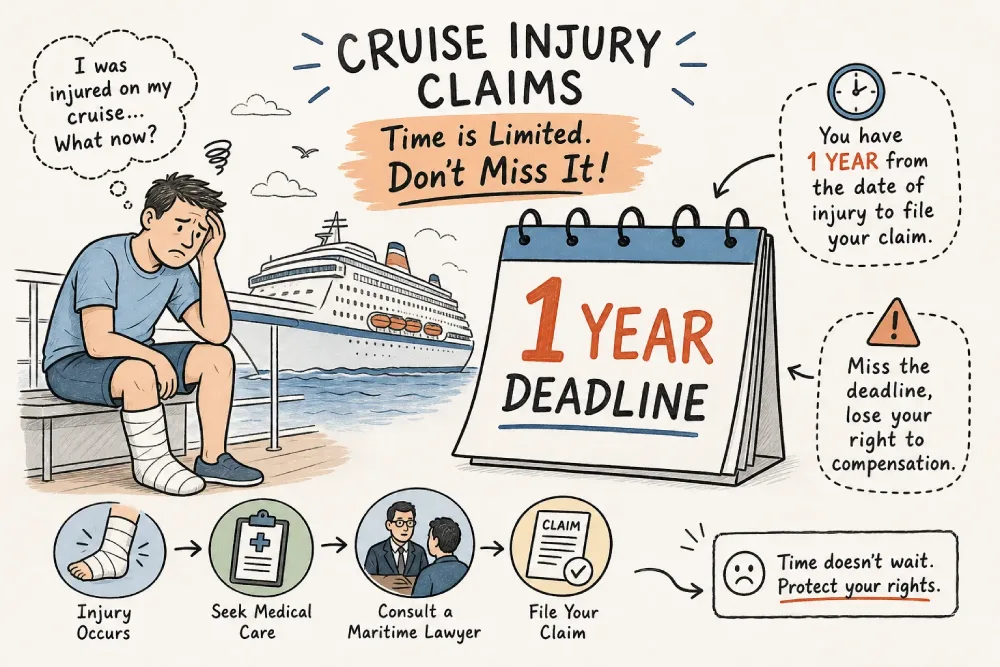
Many injured cruise passengers assume they have years to decide whether to file a lawsuit. They don’t. The one-year filing limit for cruise injury claims is written into your ticket contract before you ever board the ship, and federal courts routinely enforce it, with only narrow exceptions. Under 46 U.S.C. § 30526, cruise lines are legally permitted to shrink your lawsuit deadline from the standard three-year maritime window down to just one year. Stack a separate six-month written notice requirement on top of that, and the margin for error becomes razor thin.
At Irwin Law Firm, we handle cruise ship injury cases regularly. The pattern we see most often is passengers who waited too long because they didn’t know the rules. This guide lays out exactly what those rules are, when your clock starts ticking, and what you need to do right now to protect your claim.
Why cruise lines can legally shorten your time to sue
The federal statute that makes this possible is 46 U.S.C. § 30526. In plain terms, it permits cruise lines operating seagoing passenger vessels to cap the lawsuit filing period at one year from the date of injury or death. That’s the floor, not the ceiling, and cruise lines use it as the standard. To understand why this matters, compare it to 46 U.S.C. § 30106, the general maritime statute of limitations that gives most maritime injury victims three full years to file. The cruise ticket contract is what activates the shorter deadline and triggers the one-year filing limit for cruise injury claims.
The mechanism is simple: when you purchase a cruise ticket and board the ship, you are bound by every term printed in that contract, including its limitation clauses. Federal courts have consistently enforced cruise ticket contracts as binding commercial agreements even when passengers never read them. The fact that the terms weren’t negotiated, weren’t explained at check-in, and weren’t handed to you in plain language doesn’t matter under existing case law, including the U.S. Supreme Court’s ruling in Carnival Cruise Lines, Inc. v. Shute, which upheld these clauses as valid and enforceable. That said, enforceability is subject to recognized limits, such as claims of unreasonableness or violations of public policy.
Florida’s general personal injury statute of limitations has shifted over recent years, but under a cruise ticket contract, you get one year regardless of what state law might otherwise allow. That distinction is not theoretical. It ends otherwise valid claims with enough regularity that cruise lines have built their entire legal defense strategy around it.
When the one-year filing limit for cruise injury claims starts
The filing period almost always begins on the date the injury occurred, not the last day of the cruise, not when you returned home, and not when a doctor confirmed your diagnosis. Federal courts applying maritime law measure the one-year period from the moment the accident happened. Carnival’s ticket contract makes this explicit: no claim is maintainable unless filed within one year after the date of the injury, event, illness, or death.
Some injury victims assume the clock starts when they first understand the full extent of what happened to them. In standard cruise passenger injury cases, that reasoning rarely holds. The discovery rule, which delays the start of a limitation period until a plaintiff reasonably discovers the harm, has limited application in this context. The injury date is the trigger. This matters especially for passengers who developed symptoms gradually or didn’t feel the full impact of an injury until days after the incident.
Consider a realistic timeline. Your injury happens on day three of a seven-day cruise. You spend three weeks recovering at home. Two months pass while you deal with insurance calls and medical appointments. Three months in, you’re still deciding whether to pursue a lawsuit. At that point, you’ve already burned through six months of your one-year window without taking a single legal step. Six months remain, and you haven’t even contacted an attorney.
The six-month written notice requirement in your ticket contract
Beyond the one-year lawsuit deadline, most cruise tickets include a separate six-month written notice requirement. This clause requires the injured passenger to formally notify the cruise line in writing within 180 to 185 days of the accident. Federal law under 46 U.S.C. § 30526 allows cruise lines to impose this requirement, and it is standard practice across nearly every major carrier. Carnival sets its notice window at 185 days. Royal Caribbean uses 180 days. Norwegian and Princess follow similar provisions.
The notice must be sent in writing to the specific address named in the ticket, typically the cruise line’s legal department. For Royal Caribbean, that address is listed in the contract as 1050 Caribbean Way, Miami, FL 33132. Sending via certified or registered mail is best practice for creating verifiable proof of delivery. The notice must include the who, what, when, where, and how of the incident with enough detail for the cruise line to investigate the claim. A vague letter saying you were hurt aboard the ship is not enough.
Missing the six-month notice requirement can give the cruise line grounds to argue your claim is barred before the one-year lawsuit deadline even arrives. Courts have dismissed claims on this basis alone. The six-month notice and the one-year filing deadline are two separate obligations, and you must meet both. Satisfying only one of them is not enough to keep your claim alive.
Situations that can pause or extend the filing deadline
There are limited circumstances where the one-year deadline can be tolled, or paused. The clearest example is when the injured person is a minor. Under 46 U.S.C. § 30526(d), if a claimant is a minor or mentally incompetent, the notice period is tolled until a legal representative is appointed, or until three years after the injury, whichever comes first. The Third Circuit addressed this directly in Gibbs v. Carnival Cruise Lines, 314 F.3d 125 (3d Cir. 2002), holding that the one-year period was tolled for an injured minor until a guardian ad litem was appointed.
Incapacity is another recognized basis for tolling. If the injured passenger was mentally incapacitated in a way that prevented them from pursuing a claim, courts may pause the deadline during that period. Fraudulent concealment is also recognized: if the cruise line actively concealed the cause of an injury through destroyed records, false statements, or hidden hazards, courts have applied the fraudulent concealment doctrine to extend the filing window.
These exceptions are narrow. Relying on a tolling argument instead of filing within one year is a high-risk legal strategy, and it is not a substitute for acting before the deadline. The safer path is always to file on time and let an attorney evaluate whether any exception strengthens your position, not to count on an exception saving you after the window has closed.
How ticket clauses control where and under what law you must sue
Cruise lines don’t just limit your filing deadline. They also dictate where you must file. Carnival’s ticket contract requires litigation in the U.S. District Court for the Southern District of Florida, which covers Miami. If federal jurisdiction is lacking, the contract points to Miami-Dade County state court. The Supreme Court upheld this type of clause in Carnival Cruise Lines v. Shute, which means that in most cases you cannot sue in your home state court, regardless of where you live, where the accident happened, or where the cruise departed from. Courts can still reject such clauses in cases involving unreasonableness or applicable mandatory law, but those challenges are difficult to win.
Choice-of-law clauses add another layer. These provisions specify the substantive law that governs your injury claim, often U.S. general maritime law or Florida law. The governing law affects available damages, available defenses, and procedural rights. Filing under the wrong legal framework in the wrong court can result in dismissal, even if the claim itself is otherwise valid. These clauses work together as a system designed to put the cruise line in familiar territory and keep injured passengers off balance.
What to do right now to protect your cruise injury claim
Start with evidence. Save every medical record, every incident report filed aboard the ship, every photograph of the hazard that caused your injury, and every name and contact number for witnesses. Request a copy of the ship’s incident report before you disembark. Once you leave the vessel, your access to onboard evidence effectively disappears. The ship moves on. Crew members rotate. Video footage may be overwritten before any preservation request reaches the cruise line. You get one opportunity to capture what’s available, and that window closes the moment you leave the ship.
Send written notice to the cruise line before six months pass, regardless of whether you’ve made a final decision about pursuing a lawsuit. The six-month clock runs regardless of your intentions. Draft a written summary of the injury covering the date, the specific location aboard the vessel, and the circumstances of the incident, along with your name, contact information, and a description of your injuries. Send it via certified mail to the address listed in your ticket contract and keep the receipt and tracking confirmation. That documentation could be critical if the cruise line later disputes whether proper notice was given.
The non-negotiable step is contacting a maritime attorney well before the one-year mark, not after. David Irwin at Irwin Law Firm has spent over two decades handling cruise ship injury claims in Florida’s federal courts, including the Southern District of Florida where Carnival and other major lines require passengers to file. The one-year filing limit for cruise injury claims is strict, and courts rarely make exceptions for passengers who simply waited too long. A maritime attorney can determine whether your claim is viable, confirm what notice must be sent, identify which court has jurisdiction, and advise on what evidence needs to be preserved immediately.
What injured cruise passengers actually face before the deadline
Injured cruise passengers face overlapping deadlines that most general personal injury attorneys don’t fully understand. A one-year lawsuit deadline that begins the day of the accident, not the day you got home or the day your doctor signed off on a diagnosis. A six-month written notice requirement that must be satisfied independently of the lawsuit deadline. Ticket clauses that dictate exactly which court you must use and which law applies to your case. Miss any one of these, and the cruise line will move to dismiss.
None of these rules are intuitive. All of them are enforceable. Cruise lines set these deadlines deliberately, and they know time pressure works in their favor. The passengers who protect their claims move quickly, document everything, and work with an attorney who understands admiralty law, not just general personal injury practice.
If you or a family member was injured on a cruise ship, contact Irwin Law Firm before that clock runs out. We will tell you exactly where you stand, what the one-year filing limit for cruise injury claims means for your specific situation, and how to protect every right you have under maritime law. Call us before the deadline, not the day after it expires.
Protect Your Claim Before Time Runs Out: Contact Irwin Law Firm Today
Navigating strict maritime deadlines requires immediate action and experienced legal counsel. Cruise lines design these ticket contract limitations to work in their favor, but you do not have to fight them alone. With over two decades of experience handling cruise ship injury claims in Florida’s federal courts, attorney David Irwin at Irwin Law Firm knows how to enforce your rights, meet mandatory notice windows, and build a strong case under admiralty law. Do not wait until the clock runs out—contact us today for a comprehensive case evaluation or call us at 954-775-2301 before your deadline expires.